Crochet Baby Hooded Cape: Free Pattern, 0–12 Months
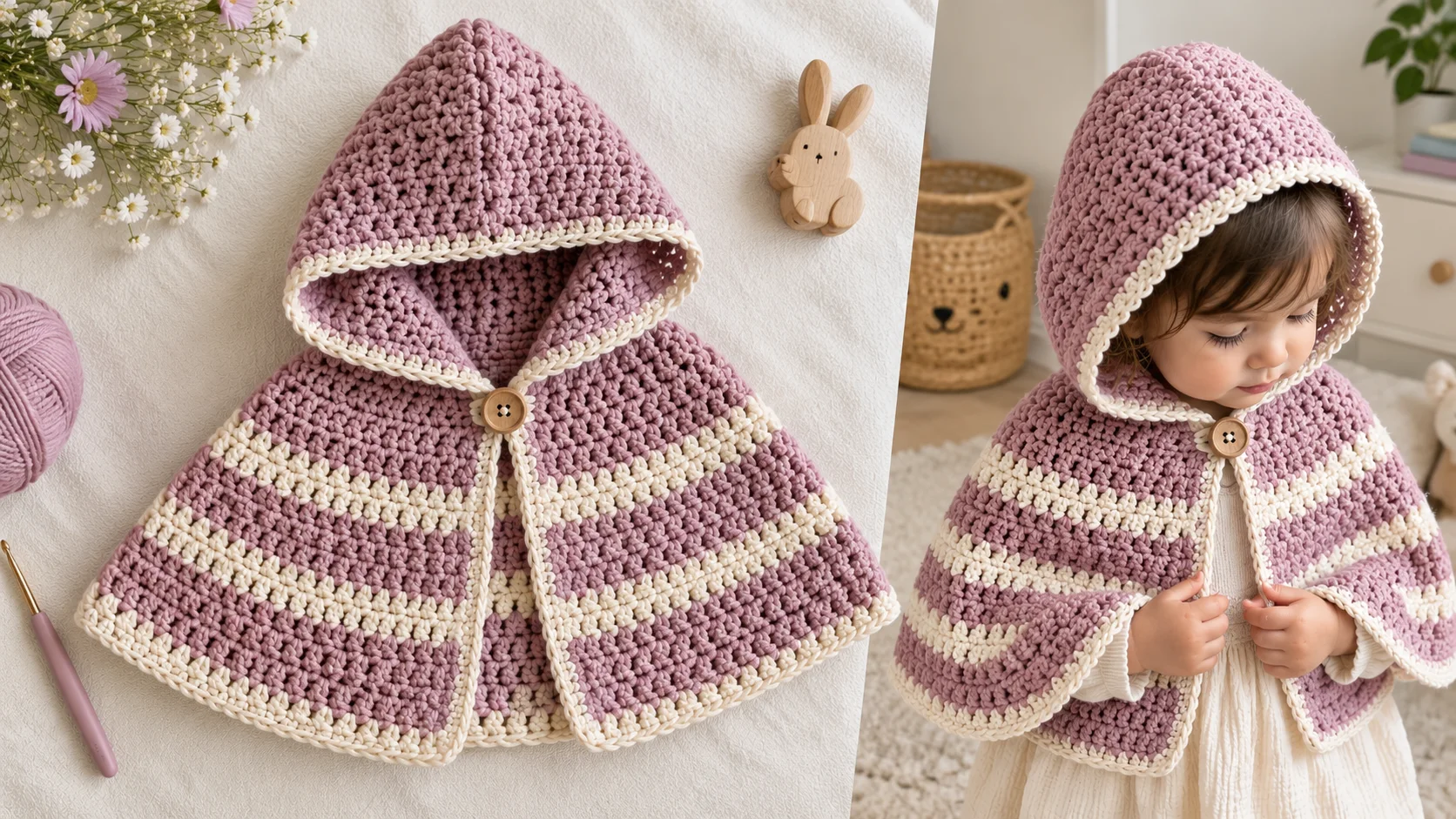
Wrestling a wiggly baby’s arms into jacket sleeves is nobody’s favorite part of a cold-weather outing. A crochet baby hooded cape fixes that: it drapes over the shoulders, overlaps (or fastens) at the chest, and keeps your little one warm without a single sleeve. This free crochet baby hooded cape pattern covers three sizes, from newborn to 12 months, using only basic double crochet. You’ll also get a safety checklist, size chart, yarn yardage, troubleshooting tips, and an FAQ.
Table of Contents
Quick answer: A crochet baby hooded cape is a sleeveless, open-front baby garment with an attached hood, worked in double crochet. This beginner pattern comes in three sizes (0–3, 3–6, and 6–12 months), uses DK (#3) yarn and a 4.5 mm hook, and takes roughly 4–8 hours.
Project Snapshot
| Detail | Info |
|---|---|
| Skill level | Beginner (chain, double crochet, single crochet, slip stitch, simple seaming) |
| Time | About 4–8 hours, depending on size and experience |
| Sizes | 0–3 months, 3–6 months, 6–12 months |
| Yarn weight | DK / light (#3) |
| Hook | 4.5 mm (US 7), or the size needed to match gauge |
| Yardage per size | About 260 / 320 / 380 yd (238 / 293 / 347 m) |
| Gauge | 16 dc and 8 rows = 4 in (10 cm) |
| Hood style | Worked upward from the neck edge, then folded and seamed on top |
| Closure | Optional short loop and flat button (skip for newborns) |
| Seasonality | Fall and spring in cotton or bamboo blends; a winter layer in superwash merino |
What Is a Crochet Baby Hooded Cape?
A crochet baby hooded cape is a sleeveless, open-front garment that drapes from the shoulders and includes an attached hood. Also called a crochet baby cape with hood, it goes on in seconds, so it works well as a baby shower gift and a cozy layer for strollers and carriers. Think of it as a wearable blanket with a hood. If your baby needs sleeves, our crochet baby cardigan pattern is a good alternative. Here is how it compares with other baby layers:
| Garment | Sleeves | Ease of dressing | Car-seat suitability |
|---|---|---|---|
| Hooded cape | None | Easiest: drape and overlap | Take off before buckling; lay over the harness |
| Poncho | None or short | Pulls over the head; fussier | Same bulk concerns as a cape |
| Cardigan | Yes | Hardest: arms must be threaded | Thin knits only; avoid bulky layers |
Baby Safety Checklist Before You Start
Safety comes first with any baby garment, so review this checklist before you pick up your hook. A crochet baby hooded cape should be soft, flat, and free of anything small or long near the face and neck. Always supervise your baby while they wear it.
- No long ties or drawstrings. Cords near the neck are a strangulation hazard, and the CPSC cautions against drawstrings on children’s clothing. Use a short, flat closure or none at all.
- Skip buttons and pom poms on a newborn crochet hooded cape. Both can come loose and become choking hazards. For older babies, sew a flat button on with several passes of strong thread and check it before each wear.
- Choose gentle fibers. Pick soft, machine-washable yarn (OEKO-TEX certified if possible) and avoid scratchy or shedding yarns near the face.
- Not for car seats or sleep. The AAP advises against bulky layers under car seat harnesses and against loose, soft items in a baby’s sleep space. Remove the cape before buckling in, and never leave it on a sleeping baby.
- Check stitches and ends. Weave in every end securely and keep any lace holes small so tiny fingers can’t catch.
Size Chart for Your Crochet Baby Hooded Cape (0–12 Months)
Measure the baby’s chest and choose the closest size below. Measurements are approximate, so cross-check them against the Craft Yarn Council’s standard body measurement charts.
| Size | Baby chest (approx.) | Cape hem width | Cape length | Hood depth | Foundation chain |
|---|---|---|---|---|---|
| 0–3 months | 16 in (41 cm) | 22 in (56 cm) | 10 in (25 cm) | 7 in (18 cm) | Ch 42 |
| 3–6 months | 17 in (43 cm) | 24 in (61 cm) | 11 in (28 cm) | 7.5 in (19 cm) | Ch 50 |
| 6–12 months | 18 in (46 cm) | 26 in (66 cm) | 12 in (30 cm) | 8 in (20 cm) | Ch 58 |
Choose by measurement rather than age, because babies of the same age vary widely. For a newborn crochet hooded cape, start with the 0–3 month size; when in doubt, size up for extra room to grow.
Yarn and Materials for a Baby Hooded Cape
The best yarn for a baby hooded cape is soft, machine-washable DK weight. Here is how the common fibers compare:
| Fiber | Softness | Warmth | Washability | Best season |
|---|---|---|---|---|
| Cotton | Medium | Low | Machine washable; can stretch when wet | Spring, summer, mild fall |
| Baby acrylic | Medium–high | Medium | Very easy; may pill | Year-round, budget-friendly |
| Superwash merino | Very high | High | Gentle cycle, cool water | Fall and winter |
| Bamboo blend | High, silky | Low–medium | Gentle wash; drapes and stretches | Spring and summer |
| Size | Approx. yardage | Skeins (about 250 yd each) |
|---|---|---|
| 0–3 months | 260 yd (238 m) | 2 |
| 3–6 months | 320 yd (293 m) | 2 |
| 6–12 months | 380 yd (347 m) | 2 |
These are estimates, so buy an extra skein from the same dye lot if your gauge runs loose. Also gather: a 4.5 mm (US 7) hook, tapestry needle, scissors, stitch markers, a measuring tape, and an optional flat sew-through button, about 3/4 in (2 cm).
Abbreviations and Gauge
This pattern uses US crochet terms:
- ch: chain
- sl st: slip stitch
- sc: single crochet
- dc: double crochet
- st(s): stitch(es)
- inc: 2 dc in the same stitch
The ch 2 at the start of each dc row does not count as a stitch.
Gauge swatch: Ch 22, dc in the 3rd ch from the hook and across (20 dc), then work 10 rows of dc. Lightly steam or wet-block it, then measure the center. You want 16 dc and 8 rows = 4 in (10 cm). If you get more stitches per 4 in, use a larger hook; if fewer, use a smaller one.
How to Crochet a Baby Hooded Cape (Step by Step)
Work your crochet baby hooded cape from the neck down, then build the hood directly on the neck edge. Numbers are given as 0–3 / 3–6 / 6–12 months.
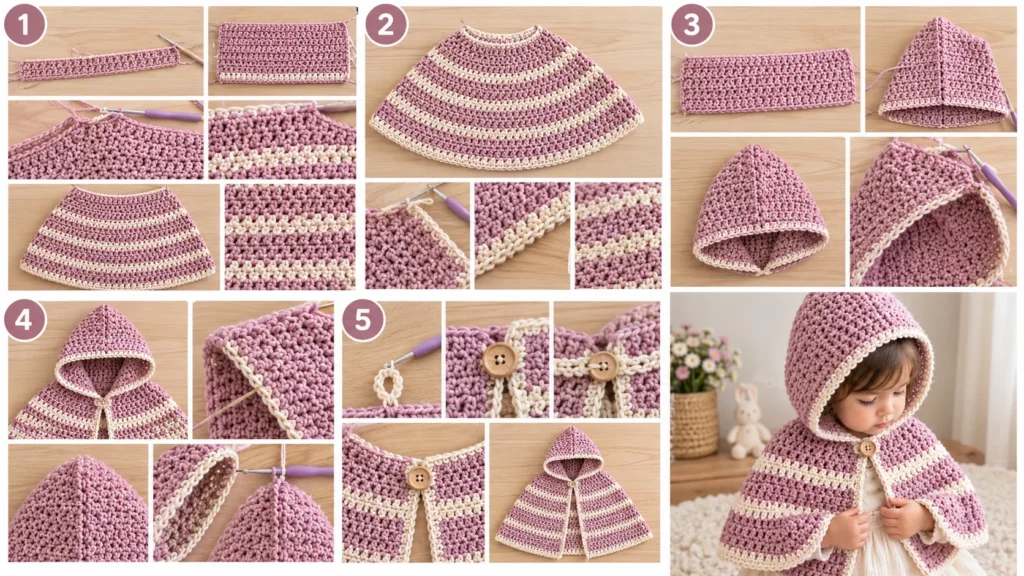
Step 1: Crochet the Cape Body
Foundation: Ch 42 / 50 / 58.
Row 1: Dc in the 3rd ch from the hook and in each ch across. (40 / 48 / 56 dc)
Rows 2–7 (increase rows): Ch 2, turn. Repeat [dc in the next n sts, 2 dc in the next st] 8 times across. Use the n value for each row from the table.
| Row | n (0–3 / 3–6 / 6–12) | Stitches after the row |
|---|---|---|
| 2 | 4 / 5 / 6 | 48 / 56 / 64 |
| 3 | 5 / 6 / 7 | 56 / 64 / 72 |
| 4 | 6 / 7 / 8 | 64 / 72 / 80 |
| 5 | 7 / 8 / 9 | 72 / 80 / 88 |
| 6 | 8 / 9 / 10 | 80 / 88 / 96 |
| 7 | 9 / 10 / 11 | 88 / 96 / 104 |
Rows 8–20 / 8–22 / 8–24: Ch 2, turn, dc in each st across. Repeat until the cape measures 10 / 11 / 12 in (25 / 28 / 30 cm) from the foundation chain. (88 / 96 / 104 dc)
Check your work: Row 7 should have 88 / 96 / 104 stitches. If your count is off, find the row where it changed before moving on.
Step 2: Edge the Front and Hem, and Prep the Neckline
With the right side facing, join yarn at the neck edge of one front. Ch 1, work 2 sc in each row-end down the front edge (40 / 44 / 48 sc), 3 sc in the corner, 1 sc in each st across the hem (88 / 96 / 104 sc), 3 sc in the next corner, then 2 sc in each row-end up the other front edge (40 / 44 / 48 sc). Fasten off. Leave the neck edge (the foundation chain) unworked, because the hood grows from it.
Step 3: Build the Hood
Rotate the cape so the foundation chain is at the top. Join yarn at one front corner of the neck edge, ch 2, then dc into each free loop of the foundation chain across. (40 / 48 / 56 dc)
Rows 2–14 / 2–15 / 2–16: Ch 2, turn, dc in each st across. Repeat until the hood measures 7 / 7.5 / 8 in (18 / 19 / 20 cm) from the neck edge. (40 / 48 / 56 dc)
The hood is as wide as the neck edge and tall enough to reach above the crown. Before you stop, hold it up to the baby’s head, or a doll’s head, to confirm it covers the top with a little room to spare.
Step 4: Attach and Shape the Hood
Because you worked the hood into the neck edge, it is already attached. To shape it, fold the hood in half so the top edges meet, right side out. Using a tapestry needle and a mattress stitch, seam the top edge (20 / 24 / 28 sts on each side).
Then edge the face opening: join yarn at the neck edge of one front, ch 1, and work 2 sc in each row-end up the hood front (28 / 30 / 32 sc), continue across the top of the seam, and work 2 sc in each row-end down the other hood front (28 / 30 / 32 sc). Fasten off.
Step 5: Add a Safe Closure and Finish
For 3–6 and 6–12 months, attach yarn at one front neck edge, ch 6, and sl st back into the same stitch to make a small loop. Sew a flat, sew-through button to the other front so the loop slips over it. For newborns, skip the closure: let the fronts overlap over a snug layer. Weave in all ends securely, then lightly steam or wet-block to shape the hood.
Customizations
Make your crochet baby hooded cape your own with these swaps:
- Length: Add or remove plain dc rows in Rows 8 onward.
- Stripes: Change color every 2 rows in the plain section, and weave in every end securely.
- Bear or bunny ears: Crochet two flat half-circles (bear) or long ovals (bunny) and sew them firmly to the hood. For a newborn, leave the hood plain.
- Lace version: Swap the plain dc rows for a V-stitch (dc, ch 1, dc in the same st, skip 1). The stitch counts stay even, and the cape feels breezier for spring.
- Toddler size (12–24 months): Ch 66, Row 1 = 64 dc, use n = 7, 8, 9, 10, 11, 12 in Rows 2–7 (112 dc), work the body to 13 in (33 cm), and make the hood 17 rows. Plan on about 450 yd (411 m).
Care and Storage
To keep your crochet baby hooded cape soft and in shape, follow the yarn label first. In general, hand wash or use a gentle machine cycle in cool water with mild detergent. Press out water in a towel instead of wringing, then dry flat and reshape the hood and edges. Never hang a wet crochet cape, because the weight stretches it. Wet-block after finishing to relax the hem and straighten the front edges. Store folded flat, not on a hanger.
Troubleshooting
Most problems with a crochet baby cape with hood come down to gauge and blocking.
Why is my cape curling or cupping?
Usually the increases are too tight for your gauge. Go up a hook size for Rows 2–7, double-check the stitch count after Row 7, and wet-block the cape flat.
Why are the front edges flaring out?
The increases create a gentle A-line, so a slight flare is normal. For straighter edges, work the sc edging with a hook one size smaller and pin the fronts straight while blocking.
Why is the hood too tight?
Hood width comes from the neck edge, so a tight gauge shrinks it. Go up a hook size for the hood, and check that it feels roomy over the baby’s head before seaming.
Why does the fabric feel stiff?
The hook may be too small or the stitches too tight. Go up a hook size, choose a drapey DK fiber such as superwash merino or a bamboo blend, and wet-block to soften the drape.
FAQ
What size crochet baby hooded cape fits a newborn?
The 0–3 month size fits most newborns. Its 10 in (25 cm) length and 22 in (56 cm) hem sit comfortably over a snug onesie. Babies vary, so measure the chest and head first and choose by measurement rather than age to keep the hood and hem comfortable.
How much yarn do I need for a crochet baby hooded cape?
Plan on about 260 yd (238 m) of DK yarn for 0–3 months, 320 yd (293 m) for 3–6 months, and 380 yd (347 m) for 6–12 months. Tension changes usage, so buy one extra skein from the same dye lot.
What is the best yarn for a baby hooded cape?
Soft, machine-washable DK yarn works best. Superwash merino is the warmest and softest for winter, baby acrylic is a budget-friendly all-rounder, and cotton or bamboo blends suit mild weather. Look for OEKO-TEX certified yarn when you can, and avoid scratchy, shedding, or fuzzy yarns near the face.
Is a crochet baby hooded cape safe in a car seat?
Not while buckled in. A cape bunches behind a baby’s back and can leave harness straps loose. Take it off before buckling, then lay it over the harness like a blanket. Always follow your car seat manual and AAP guidance on winter layers.
How long does a crochet baby hooded cape take to make?
Most beginners finish in about 4–8 hours, depending on size and speed. The cape body is plain double crochet rows, the hood adds about a third more time, and edging and seaming take about an hour. Splitting the project over two or three evenings keeps it relaxed.
Crochet baby hooded cape vs poncho: which is better?
A baby cape opens at the front and drapes over the shoulders, so nothing has to be pulled over the head. A poncho is closed and goes on over the head, which can be fussy with newborns. Capes are easier to put on; ponchos stay in place better.
Can I make the crochet baby hooded cape in toddler size?
Yes. Chain 66 and work 64 double crochet, then use n values of 7 through 12 in Rows 2–7 to reach 112 stitches. Work the body to 13 in (33 cm) and the hood for 17 rows. Expect to use about 450 yd (411 m) of DK yarn.
Key Takeaways
- A crochet baby hooded cape is the easiest way to keep a baby warm without wrestling sleeves.
- Choose your size by measurement: 0–3, 3–6, or 6–12 months.
- Safety first: no long ties, no buttons or pom poms on newborns, and never in a car seat or for sleep.
- Use soft, machine-washable DK yarn, a 4.5 mm hook, and about 260–380 yd.