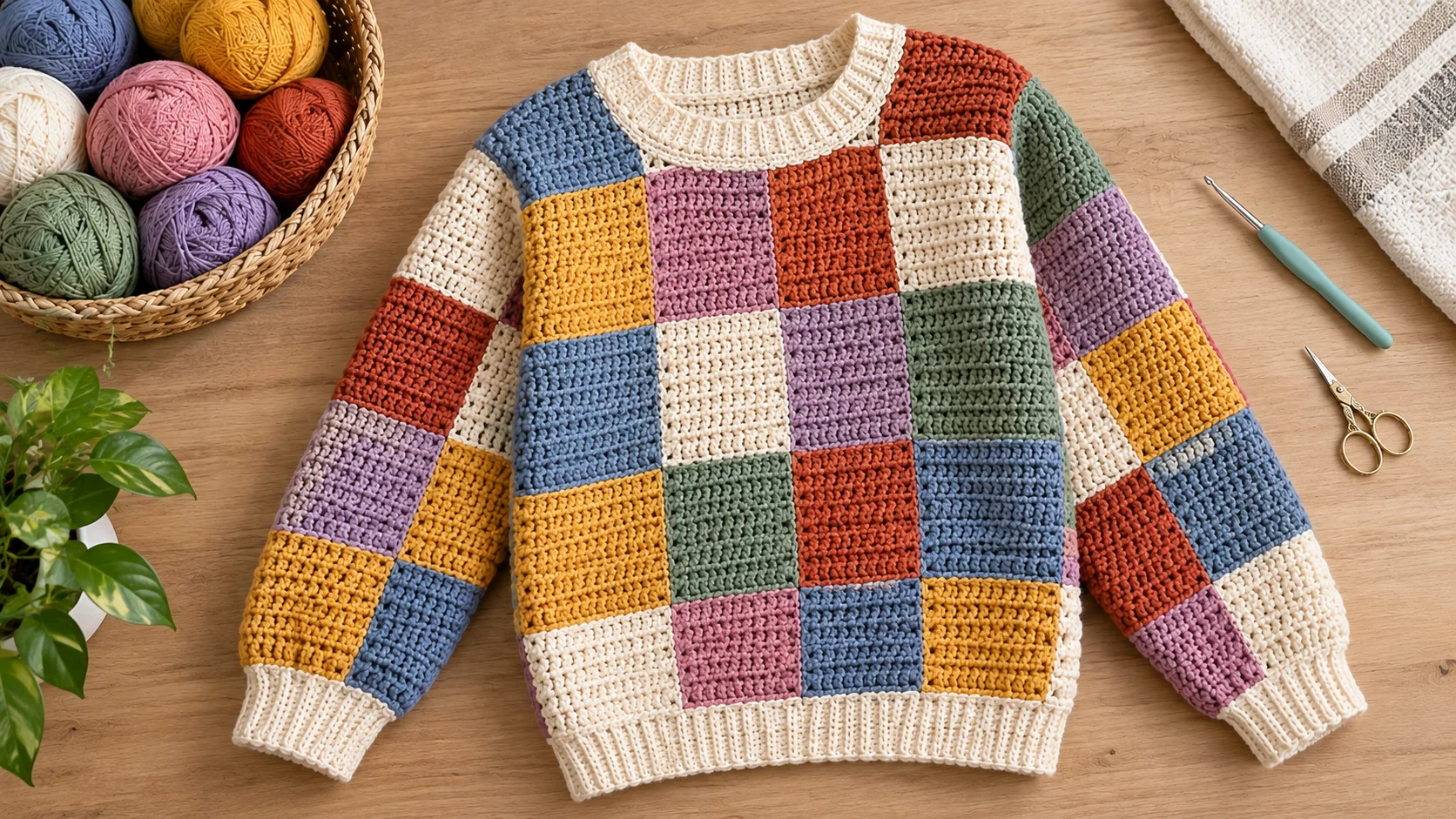
Free Crochet Patchwork Sweater Pattern: Sizes XS–4XL
Quick Answer: A crochet patchwork sweater is a garment constructed by stitching together individual crochet squares—most commonly solid half-double crochet squares or classic granny squares—into front, back, and sleeve panels before seaming. This beginner-friendly project requires worsted weight yarn, a 5.0 mm (H-8) hook, and basic seaming knowledge.
Every square in a crochet patchwork sweater is a tiny, portable project, so this is one of the most relaxing garments to make, and no two colorways ever turn out alike. This free crochet patchwork sweater pattern covers what most tutorials skip: a full XS–4XL size matrix, blocking, a seaming comparison, ribbing, and troubleshooting. Prefer a front opening? You’ll also learn how to turn it into a crochet patchwork cardigan.
Table of Contents
Crochet Patchwork Sweater at a Glance
| Detail | Specification |
|---|---|
| Skill Level | Advanced Beginner |
| Square Dimensions | 5.5″ × 5.5″ (14 × 14 cm) |
| Yarn Weight | Worsted (Category 4 / 10-ply) |
| Hook Size | 5.0 mm (US H-8) and 4.0 mm (US G-6 for ribbing) |
| Time to Complete | ~15–20 hours |
Materials & Yarn Requirements for Your Crochet Patchwork Sweater
Choose a smooth, springy worsted weight yarn with crisp stitch definition and good drape. The budget pick is Caron Simply Soft, a washable acrylic with roughly 315 yds (288 m) per 6 oz skein. For a premium natural-fiber option, try Cascade 220, a hard-wearing wool with roughly 220 yds (200 m) per 100 g skein that blocks beautifully. Always confirm yardage on your own label.
You’ll also need a 5.0 mm (H-8) hook, a 4.0 mm (G-6) hook for ribbing, a tapestry needle, stitch markers, blocking mats, and rust-proof pins.
Yarn calculator: Each square uses about 29 yds (26.5 m), seaming included. Multiply your square count by 29, divide by the yardage per skein, and round up. Planning a scrappy, multicolor crochet patchwork sweater? Divide the squares among your colors first, then calculate each color separately.
| Size | Total Yards / Meters | Simply Soft Skeins (~315 yds) | Cascade 220 Skeins (~220 yds) |
|---|---|---|---|
| XS/S | 1,400 / 1,280 | 5 | 7 |
| M/L | 1,750 / 1,600 | 6 | 8 |
| XL/2XL | 2,220 / 2,030 | 8 | 11 |
| 3XL/4XL | 2,630 / 2,405 | 9 | 12 |
Square Sizing & Layout Matrix (XS to 4XL)
Use this matrix to choose your size and plan every panel of your crochet patchwork sweater before picking up a hook. Body grids read width × height in squares; sleeve grids read width × length. Each blocked square measures 5.5″ (14 cm), so a 4 × 4 panel is 22″ × 22″ (56 × 56 cm).
| Size | Bust Measurement | Total Squares Needed | Front Panel Grid | Back Panel Grid | Sleeve Grid (Each) | Total Yardage (yds/m) |
|---|---|---|---|---|---|---|
| XS/S | 32″–36″ | 48 Squares | 3 × 4 | 3 × 4 | 2 × 6 | 1,400 / 1,280 |
| M/L | 38″–42″ | 60 Squares | 4 × 4 | 4 × 4 | 2 × 7 | 1,750 / 1,600 |
| XL/2XL | 44″–48″ | 76 Squares | 5 × 4 | 5 × 4 | 3 × 6 | 2,220 / 2,030 |
| 3XL/4XL | 50″–54″ | 90 Squares | 6 × 4 | 6 × 4 | 3 × 7 | 2,630 / 2,405 |
Totals cover the front, back, and both sleeves. Every sleeve row adds 5.5″, so drop a row if your arms run short. Between sizes? Choose by bust measurement and how much ease you like.
Gauge Swatch & Why It Matters
Gauge matters more in a crochet patchwork sweater than in most garments, because a small error repeats in every square. This free crochet patchwork sweater pattern assumes 14 sts × 10 rows in HDC = 4″ (10 cm) with a 5.0 mm hook. Work a 6″ swatch first: too many stitches means go up a hook size; too few means go down.
Warning: A variance of just 0.5 inches per square alters your final garment width by up to 3 inches.
The Solid Patchwork Square Pattern (Written Instructions)
Make the number of squares listed for your size. All terms are US.
- Foundation: Ch 20.
- Row 1: Hdc in the 3rd ch from the hook and in each ch across (19 sts; the skipped chains count as the first hdc).
- Row 2: Ch 2 (counts as the first hdc), turn. Hdc in each st across, working the last hdc into the top of the turning chain (19 sts).
- Rows 3–14: Repeat Row 2.
- Finish: Fasten off and weave in the ends. The square should measure about 5.5″ × 5.5″ (14 × 14 cm) after blocking.
Tip: US vs. UK terms. This pattern uses US terminology. In UK terms, half-double crochet (hdc) is half treble (htr), single crochet (sc) is double crochet (dc), and double crochet (dc) is treble (tr).
Granny Square Alternative (For a Boho Look)
Want a boho crochet patchwork sweater? Swap in this classic granny square, worked with the same 5.0 mm hook.
- Rnd 1: Make a magic ring. Ch 3 (counts as dc), 2 dc, ch 2; [3 dc, ch 2] 3 times; join with a sl st to the top of the beginning ch 3.
- Rnd 2: Sl st into the first ch-2 corner space. Ch 3, (2 dc, ch 2, 3 dc) in the same space, ch 1; (3 dc, ch 2, 3 dc) in the next corner space, ch 1; repeat around and join.
- Rnds 3–4: Work the corners as in Rnd 2, adding 3 dc, ch 1 in each side space between corners.
- Finish: Fasten off, weave in the ends, and block to 5.5″. Granny squares work up at a different gauge than HDC, so swatch one and adjust your hook size to match.
How to Block Your Squares Before Seaming
Most patchwork tutorials skip this step, yet blocking is what makes a crochet patchwork sweater lie flat. Unblocked HDC squares curl and granny squares ruffle, and a quarter-inch difference per square snowballs across a six-square panel into wavy seams. Blocking every square to exactly 5.5″ lets the grid line up. Wet block wool and other natural fibers; steam block acrylic.
- Make a template. Cut a 5.5″ × 5.5″ square from cardboard, or use a gridded blocking board.
- Dampen the squares. For wet blocking, soak in lukewarm water with wool wash for 15 minutes, then press out the water in a towel without wringing. For steam blocking, hold a steamer or iron 1–2″ above the acrylic until the fabric relaxes; never press the iron down.
- Pin to size. Pin the four corners first, then every inch along the edges, matching the template.
- Check the geometry. All four sides and both diagonals should measure the same.
- Dry flat. Leave the squares pinned for 12–24 hours, then compare each one to the template and re-block outliers.
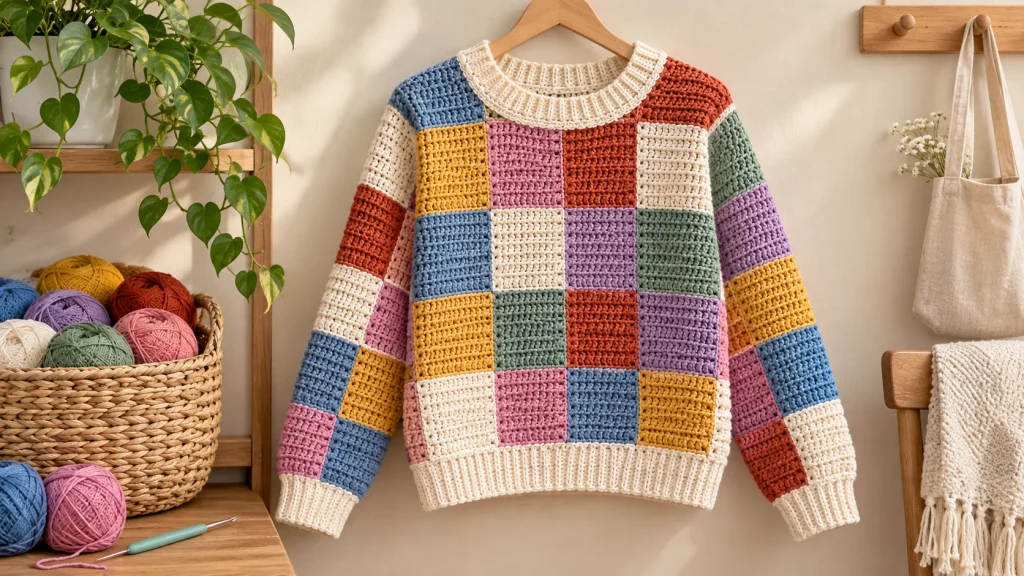
Crochet Patchwork Sweater Assembly Schematics
Lay out every panel on the floor before you seam. The M/L layout below uses four colors (A–D); each letter is one 5.5″ square, and no color touches itself edge to edge.
Front panel (4 × 4)
A B C D
C D A B
B A D C
D C B A
Back panel (4 × 4): swap A↔C and B↔D, so matching colors never meet at the shoulder or side seams.
C D A B
A B C D
D C B A
B A D C
Sleeves (2 × 7 each): use this strip for both.
A B
C D
B A
D C
A B
C D
B A- Neckline drop: For a lower front neckline, skip the two center squares of the front’s top row. The matrix assumes full rectangles, so you’ll have two spares.
- Straight cuff: Seam the underarm straight down to the cuff.
- Tapered cuff: Angle the last two squares of the underarm seam about 1″ (2.5 cm) inward, or use the cuff decrease round below.
Choosing the Best Seaming Method for Your Crochet Patchwork Sweater
Seaming can make or break the finished garment. Here is how the three most popular joins compare:
| Method | Best For | Pros | Cons |
|---|---|---|---|
| Invisible mattress stitch | Clean, flat seams with a seamless look | Nearly invisible, flexible, no bulk | Slowest method; needs even stitch counts |
| Slip stitch join (right sides facing) | Speed and structural stability | Fast, firm, beginner-friendly | Adds a slight internal ridge |
| Flat zipper join / single crochet seam | An exposed, decorative seam effect | Bold design feature, very sturdy | Visible bulk; stiffest option |
Verdict: For a first crochet patchwork sweater, the slip stitch join offers the best balance of speed and strength. Choose mattress stitch for the most polished finish, and the single crochet seam when you want the grid itself to become the design.
Step-by-Step Assembly Order
- Join square rows into individual panels. Seam squares into horizontal strips, then join the strips, using the same method and tension throughout.
- Seam the shoulders. Join front to back from the outer edges inward, leaving 10–11″ (25–28 cm) open for the neck.
- Attach sleeves flat to the body. Match the center of each sleeve’s short edge to the shoulder seam and seam outward before folding anything.
- Close the side seams and underarms. Fold at the shoulders and seam from the hem up the side, across the underarm, and down the sleeve in one continuous pass.
Adding Knit-Look Ribbing (Waist, Collar, Cuffs)
Ribbing gives a crochet patchwork sweater clean, stretchy edges. Use your 4.0 mm (G-6) hook for either method.
Option 1: BLO SC ribbing (worked sideways)
- Ch 11.
- Row 1: Sc in the 2nd ch from the hook and across (10 sc).
- Row 2: Ch 1, turn. Sc in the back loop only (BLO) of each st across.
- Repeat Row 2 until the strip measures about 90% of the hem or cuff circumference. Seam the short ends, then slip stitch the band to the edge, easing any extra stitches evenly.
Option 2: FPDC/BPDC ribbing (worked in the round)
- Rnd 1: Join yarn at the edge, ch 1, and sc evenly around (use an even number of sts). Join with a sl st.
- Rnd 2: Ch 2 (does not count as a st). FPDC in the next st, BPDC in the next st; repeat around and join to the first FPDC.
- Rnds 3–10: Repeat Rnd 2 for about 3″ (7.5 cm). Use 5–6 rounds for the collar.
Gathered balloon-sleeve cuffs: On the cuff, make Rnd 1 a multiple of 4 stitches. Then work a decrease round: sc in the next 2 sts, sc2tog; repeat around. This removes one quarter of the stitches (40 becomes 30), gathering the sleeve into a soft balloon. If the total is odd, add one sc, then continue with Rnds 2–10 above.
Common Crochet Patchwork Sweater Mistakes & How to Fix Them
Three problems come up again and again, and each has a simple fix.
- Problem: The sweater is too stiff and cardboard-like. Solution: Your hook was too small for the yarn. A patchwork sweater needs open, fluid fabric to drape, so go up 0.5–1.0 mm and re-swatch. HDC in worsted should fold easily over your hand.
- Problem: Wavy or uneven seams. Solution: Uneven square row counts are the usual cause. Count the stitches along every square edge (19 stitches across, 14 rows) and re-block any outliers before reseaming.
- Problem: The neckline stretches out over time. Solution: Work one round of slip stitch edging around the neck opening with a smaller hook (3.5 mm/E-4) before adding ribbing. It stabilizes the edge without adding bulk.
Frequently Asked Questions About Crochet Patchwork Sweaters
Can I turn this crochet patchwork sweater into a cardigan?
Yes. Split the front panel grid down the center into two equal halves (e.g., from a 4-square-wide panel to two 2-square-wide panels) and add a button-band or open front ribbing. For odd-width sizes (XS/S and XL/2XL), round each half up to the next whole square, which adds four squares to your total. The same gauge, blocking, and seaming order apply to your crochet patchwork cardigan.
How many squares do I need for a medium crochet patchwork sweater?
A standard medium oversized sweater typically requires 60 squares (16 for the front, 16 for the back, and 14 for each sleeve), or about 1,750 yds (1,600 m) of worsted yarn.
What is the best yarn for a crochet patchwork sweater?
An acrylic or acrylic-wool blend worsted weight (Category 4) yarn is recommended for its washability, cost efficiency, and low weight/sag compared to pure cotton. Superwash wool is a good premium alternative.
Start Your Crochet Patchwork Sweater Today
You now have a complete free crochet patchwork sweater pattern: an XS–4XL size matrix, a master square, blocking, assembly, and finishing. Swatch first, block every square, and plan your colors before you seam. Whether you stitch the pullover or the crochet patchwork cardigan variation, those three habits are what make the finished garment fit and drape beautifully.
One Comment